
Choosing a mattress seems like a simple task until you realise just how much firmness levels influence your nightly comfort. Most people do not know that proper mattress firmness can make the difference between deep sleep and waking up sore, and even impacts your spinal health over time. The real surprise is you cannot rely on the firmness scale alone because your body type, sleep position, and even your daily habits change what will actually feel right for you.
Table of Contents
- Defining Mattress Firmness Levels: What They Are
- Why Mattress Firmness Levels Matter For Your Sleep Quality
- The Science Behind Mattress Firmness And Body Support
- How Different Firmness Levels Affect Different Sleep Positions
- Real-World Considerations When Choosing Mattress Firmness
Quick Summary
| Takeaway | Explanation |
|---|---|
| Understand firmness levels (1-10) | Mattress firmness ranges from soft (1) to firm (10), influencing comfort and support. |
| Choose based on sleep position | Side sleepers need softer mattresses, while back and stomach sleepers require firmer options for alignment. |
| Personal factors shape preference | Individual traits like weight and health influence mattress firmness needs for optimal comfort. |
| Proper firmness aids health | Correct mattress support prevents pain, improves spinal alignment, and enhances sleep quality. |
| Evaluate lifestyle impact | Consider daily activities and health history when selecting mattress firmness, as they significantly affect comfort requirements. |
Defining Mattress Firmness Levels: What They Are
Mattress firmness levels are standardized measurements that describe how soft or hard a mattress feels when you lie down. These levels help consumers understand the support and comfort they can expect from a mattress. Typically, firmness is rated on a scale from 1 to 10, where 1 represents an extremely soft surface and 10 represents an extremely firm surface.
Understanding the Firmness Scale
The mattress firmness scale provides a critical framework for selecting the right sleep surface. Research from The Lancet reveals that mattress firmness directly impacts sleep quality and physical comfort. Most people find optimal comfort in the middle range of the firmness scale:
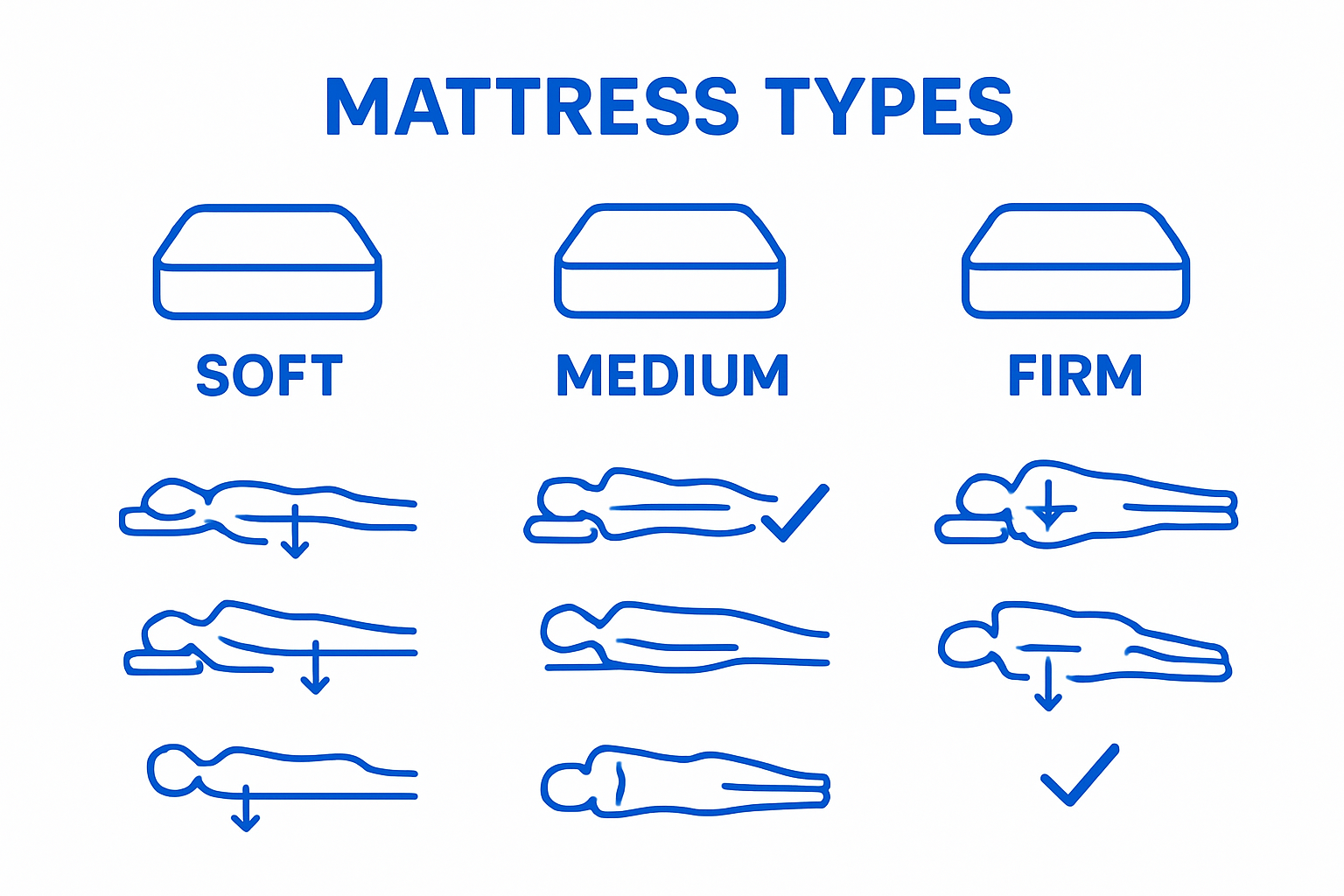
- Soft mattresses (1-3): Sink deeply, offering maximum cushioning
- Medium mattresses (4-6): Balanced support and comfort
- Firm mattresses (7-10): Provide robust support with minimal sinking
Factors Influencing Mattress Firmness Perception
Multiple elements contribute to how an individual perceives mattress firmness. Body weight, sleeping position, and personal preference play significant roles. Heavier individuals might experience a softer feel on the same mattress compared to lighter persons. Side sleepers typically require softer surfaces to accommodate shoulder and hip curves, while back and stomach sleepers often prefer medium to firm mattresses for proper spinal alignment.
Understanding mattress firmness helps you find the perfect bed for your comfort needs. When selecting a mattress, consider your individual sleep requirements, physical characteristics, and comfort preferences to ensure a restful night’s sleep.
Why Mattress Firmness Levels Matter for Your Sleep Quality
Mattress firmness is not just a technical specification but a critical factor that directly impacts your overall sleep health and physical well-being. Proper mattress firmness determines how well your body is supported during sleep, affecting everything from spinal alignment to muscular relaxation and pain prevention.
Physical Health and Spinal Alignment
Research from the National Institutes of Health demonstrates that mattress firmness plays a crucial role in maintaining proper spinal alignment. An inappropriate mattress can lead to several health complications:
- Chronic lower back pain
- Muscular tension and stiffness
- Reduced quality of sleep
- Increased risk of joint and muscle discomfort
When your mattress provides the right level of support, it helps distribute body weight evenly, reduces pressure points, and allows muscles to relax completely during sleep.
 This is particularly important for individuals with existing musculoskeletal conditions or those prone to back and neck pain.
Individual Comfort and Sleep Quality
Each person’s body is unique, which means mattress firmness is not a one-size-fits-all solution. Factors like body weight, sleeping position, and personal comfort preferences significantly influence the ideal mattress firmness. Learn more about selecting the perfect bed for your comfort needs.
Side sleepers typically require softer mattresses that cushion shoulders and hips, while back and stomach sleepers benefit from firmer surfaces that maintain proper spinal alignment. By understanding and selecting the right mattress firmness, you can transform your sleep experience, improve physical recovery, and enhance overall health and well-being.
The Science Behind Mattress Firmness and Body Support
Mattress firmness is more than a subjective comfort preference it is a complex interplay of biomechanical principles and human physiology. The scientific understanding of mattress support involves analyzing how different surfaces interact with human body mechanics, distributing weight, maintaining spinal alignment, and promoting muscular relaxation.
Biomechanical Pressure Distribution
Research published in biomechanical studies reveals that mattress firmness directly influences pressure point management and body weight distribution. Different firmness levels create unique pressure mapping across body regions:
- Soft mattresses allow deeper sinking, increasing surface contact
- Medium mattresses provide balanced pressure redistribution
- Firm mattresses minimize sinking and maintain strict body positioning
The goal of proper mattress support is to create an optimal balance between pressure relief and structural alignment, ensuring that no single body part bears excessive stress during sleep.
Physiological Response to Surface Support
The human body responds dynamically to sleep surface characteristics. Mattress firmness triggers specific physiological reactions related to muscular tension, spinal curvature, and blood circulation. Explore our detailed guide on mattress selection to understand these intricate interactions.
Individual factors like body weight, muscle composition, and existing musculoskeletal conditions significantly influence how one experiences mattress support. A surface that provides precise tension distribution can reduce nighttime muscular strain, promote proper blood flow, and facilitate more restorative sleep cycles.
How Different Firmness Levels Affect Different Sleep Positions
Sleep position plays a crucial role in determining the ideal mattress firmness for optimal comfort and spinal health. Different sleeping styles demand unique support mechanisms that can significantly impact overall sleep quality and physical well-being.
Side Sleepers: Pressure Point Management
Research involving patients with musculoskeletal pain reveals that side sleepers require specific mattress characteristics to maintain proper body alignment. Side sleeping creates concentrated pressure on shoulders and hips, necessitating a different approach to mattress selection:
- Soft to medium-soft mattresses (3-5 firmness)
- Enhanced cushioning for shoulder and hip regions
- Ability to contour to body curves
- Reduced pressure on joint areas
The ideal mattress for side sleepers allows slight sinking to accommodate the body’s natural curves while providing enough support to prevent spinal misalignment.
Back and Stomach Sleepers: Structural Support
Unlike side sleepers, back and stomach sleepers require firmer mattress surfaces that maintain consistent spinal alignment. Check out our comprehensive mattress selection guide to understand these nuanced requirements.
Back and stomach sleeping positions demand:
- Medium-firm to firm mattresses (6-8 firmness)
- Minimal sinking to prevent lower back strain
- Consistent support across the entire body
- Prevention of unnatural spinal curvature
Individual variations in body weight, muscle composition, and personal comfort preferences still play a significant role in selecting the perfect mattress firmness for these sleeping positions.
The following table summarises the recommended mattress firmness levels for different sleep positions and body needs, helping to clarify the best options for each style.
| Sleep Position | Recommended Firmness Level | Support Needs | Risks of Wrong Firmness |
|---|---|---|---|
| Side Sleeper | 3-5 (Soft-Medium) | Cushions shoulders and hips, contours to body curves | Pressure on joints, poor spinal alignment |
| Back Sleeper | 6-8 (Medium-Firm) | Maintains spinal curve, offers consistent support | Lower back pain, poor buttress |
| Stomach Sleeper | 6-8 (Medium-Firm) | Prevents hips sinking, keeps spine naturally aligned | Neck/back strain, misalignment |
| Heavier Individuals | 7-10 (Firm-Extra Firm) | Prevents excessive sinking, supports body weight | Lack of support, discomfort |
| Lighter Individuals | 4-6 (Medium) | Gentle cushion, avoids excessive firmness | Hardness, pressure points |
Real-World Considerations When Choosing Mattress Firmness
Selecting the right mattress firmness involves more than theoretical understanding it requires practical evaluation of individual needs and lifestyle factors. Personal comfort is a complex interaction between physical characteristics, sleeping habits, and long-term health considerations.
Physical Characteristics and Body Composition
Research involving chronic low-back pain patients highlights that body weight and composition significantly influence mattress firmness requirements. Individuals with different physical profiles experience mattress support uniquely:
- Body weight determines surface compression
- Muscle mass affects pressure distribution
- Existing musculoskeletal conditions impact comfort needs
- Age-related changes in body composition modify support requirements
Heavier individuals typically require firmer mattresses to prevent excessive sinking, while lighter persons might find medium-soft surfaces more comfortable. The goal is achieving balanced support that maintains natural spinal alignment.
This table highlights the main factors that influence how people perceive mattress firmness, distinguishing the physical and lifestyle variables that guide selection.
| Influencing Factor | How It Affects Firmness Perception | Resulting Mattress Preference |
|---|---|---|
| Body weight | Heavier bodies compress mattress more, feels softer | Firmer mattress often needed |
| Muscle composition | More muscle spreads pressure, affects feel | Medium to firm may feel softer |
| Sleep position | Different positions put pressure on various zones | Soft for side, firm for back/stomach |
| Age and health conditions | Older adults or those with back pain need support | Balanced support, often firmer |
| Daily activity and lifestyle | Athletics, pregnancy, or injury change needs | Can vary, may need special support |
Lifestyle and Health Considerations
Beyond physical metrics, lifestyle factors play a crucial role in mattress firmness selection. Explore our comprehensive mattress selection guide to understand these nuanced requirements.
Consider how your daily activities, physical condition, and health history influence mattress choice:
- Professional athletes might need firmer surfaces for muscle recovery
- Individuals with chronic pain require specialized support
- Pregnancy introduces unique comfort and support needs
- Medical conditions like arthritis affect mattress preference
Ultimately, mattress firmness is a personal journey of balancing scientific principles with individual comfort, ensuring restful and rejuvenating sleep.
Find Your Ideal Mattress Firmness With Comfy Beds
Struggling to find the right mattress firmness that suits your sleep style and body needs? You are not alone. Too many South Africans wake up with aches because their mattress is either too soft or too firm, disrupting proper spinal alignment and overall comfort. As the article explained, choosing the correct mattress firmness is crucial for healthy sleep and pain-free mornings. But knowing your firmness preference is only half the battle. The real challenge is matching it to the best mattress for your unique body and sleeping habits.
Ready to experience tailored sleep?

Discover our wide range of Foam Mattresses designed to support every firmness need, from plush comfort to extra firm stability. Still unsure about which bed matches your comfort goals? Our O-Paedic Mattresses and full selection of major bed brands and factory-low prices make it simple to upgrade your rest. Explore our selection today and take action for a better night’s sleep. The right mattress can change your health starting tonight.
Frequently Asked Questions
What are mattress firmness levels?
Mattress firmness levels are standardized measurements that indicate how soft or hard a mattress feels when lying down, typically rated on a scale from 1 to 10.
How does mattress firmness affect sleep quality?
Proper mattress firmness ensures good spinal alignment and reduces pressure points, which can prevent discomfort and improve overall sleep quality.
Which mattress firmness is best for side sleepers?
Side sleepers typically benefit from soft to medium-soft mattresses (3-5 firmness) that provide cushioning for the shoulders and hips while keeping the spine aligned.
Why is understanding mattress firmness important for health?
Understanding mattress firmness helps in selecting the right mattress that can alleviate chronic pain, reduce muscular tension, and enhance sleep quality, which is essential for overall health.
