
Donating a mattress might sound as simple as dropping it off at the nearest charity, right? Not quite. Most charities reject over 60 percent of mattresses offered to them due to poor condition or hygiene issues. But with the right steps, your gently-used mattress could actually become a lifeline for someone rebuilding their life and avoid ending up in a landfill when it could be making a real difference.
Table of Contents
- Step 1: Assess Your Mattress Condition
- Step 2: Research Local Donation Organizations
- Step 3: Contact Donation Centers For Specifications
- Step 4: Prepare Your Mattress For Donation
- Step 5: Schedule A Pick-Up Or Drop-Off
- Step 6: Confirm Completion Of Donation Process
Quick Summary
| Key Point | Explanation |
|---|---|
| 1. Assess mattress condition before donation | Evaluate for stains, tears, and structural integrity to ensure it is suitable for recipients. |
| 2. Research local organizations for donation | Investigate charities and shelters that accept mattresses to identify proper donation channels. |
| 3. Communicate with donation centers directly | Contact organizations to confirm specific requirements and address any queries about the donation. |
| 4. Properly prepare the mattress for donation | Clean thoroughly, wrap in protective material, and document its condition for smooth processing. |
| 5. Obtain and confirm donation receipt | After donation, request a receipt and verify the mattress’s intended use for personal record-keeping. |
Step 1: Assess Your Mattress Condition
Donating a mattress requires careful evaluation to ensure it meets donation standards and provides genuine value to recipients. Understanding the condition of your mattress is the critical first step in responsible donation.
Begin by conducting a thorough visual and physical inspection of your mattress. Look for key indicators that determine its suitability for donation. Structural integrity is paramount – check for significant sagging, lumps, or visible indentations that compromise the mattress’s comfort and support. Mattresses with extensive wear and tear are unlikely to be acceptable to charitable organizations.
Carefully examine the mattress surface for stains, tears, or signs of pest infestation. Clean and intact mattresses are most likely to be accepted. Minor surface imperfections might be acceptable, but large stains, rips, or evidence of bed bugs or other insects will immediately disqualify the mattress from donation. Learn more about mattress care and maintenance to understand how proper upkeep can extend your mattress’s usable life.
Pay special attention to the mattress’s age and overall condition. Most charitable organizations prefer mattresses that are less than 10 years old and have been well-maintained. Perform a simple test by pressing down on different areas of the mattress. If it springs back quickly and maintains its shape, it’s likely still in good condition. Mattresses that have lost their resilience or show significant compression are not ideal for donation.
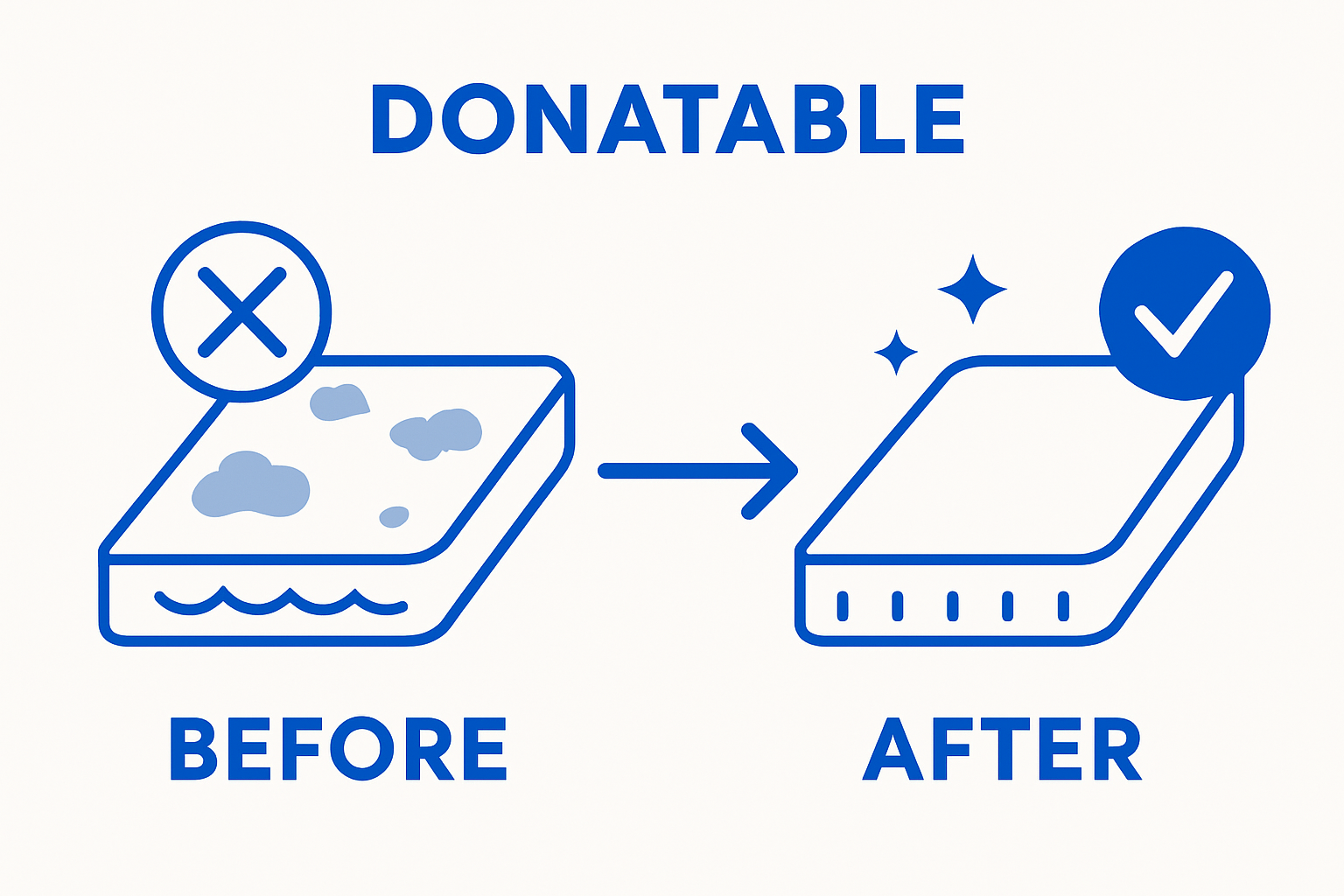
If you’re uncertain about your mattress’s condition, consider these verification criteria:
- No visible stains or tears
- Minimal wear and compression
- Free from pest evidence
- Less than 10 years old
- Retains original shape when pressure is applied
By meticulously assessing your mattress, you ensure that your donation will genuinely help someone in need, rather than creating additional burden for charitable organizations.
Below is a checklist table to help you verify whether your mattress is suitable for donation, summarising all the critical criteria you need to confirm before proceeding.
| Verification Criteria | Description |
|---|---|
| No visible stains or tears | Mattress surface is clean and free from damage |
| Minimal wear and compression | Maintains original shape, springs back with pressure |
| Free from pest evidence | No signs of bed bugs or insects |
| Less than 10 years old | Age is within commonly accepted limits |
| Structural integrity intact | No sagging, lumps, or major indentations |
Step 2: Research Local Donation Organizations
After assessing your mattress condition, the next crucial step is identifying suitable local organizations that will welcome your donation. Researching potential donation recipients requires careful consideration and strategic approach. Not all organizations accept mattress donations, so your investigation must be thorough and systematic.
Begin by exploring local charitable networks, shelters, and community support organizations. Social service agencies often maintain connections with groups needing bedding and furniture donations. Contact local homeless shelters, refugee support centers, and youth development programs. These organizations frequently require clean, functional mattresses to support individuals rebuilding their lives. Discover more about local community support networks to understand potential donation channels.
Utilize online resources and community platforms to expand your search. Websites like local government social service directories, nonprofit databases, and community forums can provide valuable information about donation opportunities. According to Sheltersuit South Africa, many organizations collaborate to support vulnerable populations, creating multiple potential avenues for mattress donations.
When contacting potential donation recipients, prepare specific questions to confirm their acceptance criteria. Key inquiries should include:
- Do they currently accept mattress donations?
- What condition requirements must the mattress meet?
- Do they offer pickup services or require drop-off?
- Are there any associated costs with donation?
Document each organization’s response carefully. Create a spreadsheet or notebook tracking potential donation sites, their contact information, specific requirements, and any additional notes from your conversations. This organized approach ensures you can efficiently match your mattress with the most appropriate recipient.
Remember that successful donation involves more than finding a willing recipient. Verify the organization’s legitimacy, check their operational history, and ensure they have a genuine need for mattress donations.
The following table compares the main types of local organisations that typically accept mattress donations and outlines their common requirements and contact approaches as mentioned throughout the article.
| Organisation Type | Typical Requirements | Common Contact Method |
|---|---|---|
| Homeless shelters | Clean, undamaged, bug-free | Phone or email |
| Refugee support centres | Recent, hygienic, well-maintained | Direct enquiry |
| Youth development programmes | Stain-free, under 10 years old | Community directories |
| Local charities (general) | Structural integrity, photos | Online forms/direct call |
| Community support organisations | No rips, pest-free, dry | Social service referrals |
Step 3: Contact Donation Centers for Specifications
Now that you have researched potential donation organizations, the next critical step is to directly contact these centers and understand their specific mattress donation requirements. Effective communication is key to ensuring your mattress meets their exact needs. This step transforms your preliminary research into actionable donation plans.
Initiate contact through multiple communication channels. Phone calls provide immediate, detailed information, while emails create a written record of your conversation. When reaching out, prepare a concise description of your mattress, including its size, age, brand, and current condition. According to U-turn Homeless Ministries, specific details help organizations quickly determine whether your donation can be accepted.
During your conversation, ask comprehensive questions that cover every aspect of the donation process. Inquire about precise condition standards, pickup or drop-off procedures, and any potential processing fees. Some organizations might have strict hygiene requirements or prefer mattresses within a specific age range. Others might offer free collection services for suitable donations.
Prepare a list of critical questions to ask during your communication:
- What are your exact mattress condition requirements?
- Do you offer free pickup for donations?
- Are there any size or age restrictions?
- Will you provide a donation receipt for potential tax purposes?
- What is your typical processing timeline?
Document each organization’s specific guidelines meticulously. Create a comparison chart noting each center’s unique requirements, contact information, and potential donation constraints. This systematic approach helps you identify the most suitable recipient for your mattress and streamlines the donation process.
Remember that flexibility and patience are essential. Not every organization will accept your mattress, and some may require additional steps like professional cleaning or inspection. If one donation center declines your mattress, use your research to quickly contact alternative organizations. Your goal is finding a responsible home for your mattress that provides genuine value to someone in need.
Step 4: Prepare Your Mattress for Donation
Preparing your mattress for donation requires meticulous attention to cleanliness, presentation, and transportation logistics. Proper preparation significantly increases the likelihood of your donation being accepted and ensures the mattress provides maximum value to its future recipient.
Begin with a comprehensive cleaning process that goes beyond simple surface wiping. Vacuum the entire mattress thoroughly, using upholstery attachments to remove dust, debris, and potential allergens from every crevice. For fabric mattresses, consider using a specialized fabric cleaner that eliminates odors and sanitizes the surface. Explore our detailed mattress care guide to understand advanced cleaning techniques that preserve mattress quality.
Addressing potential stains is crucial before donation. Use enzymatic cleaners for organic stains, carefully following product instructions to prevent fabric damage. Spot cleaning should be gentle yet thorough, ensuring no visible marks remain. If deep stains persist, professional cleaning might be necessary, or the mattress may not qualify for donation.
Prepare essential documentation and packaging for smooth donation transfer. Some organizations require proof of the mattress’s origin and condition. Take clear, well-lit photographs documenting the mattress from multiple angles. These images serve as evidence of its cleanliness and structural integrity. According to U-turn Homeless Ministries, comprehensive documentation helps streamline the donation process.
Consider these final preparation steps:
- Wrap the mattress in clean, protective plastic sheeting
- Secure wrapping with packing tape to prevent dirt accumulation
- Measure and record exact mattress dimensions
- Prepare a brief written description of the mattress condition
Transportation logistics require careful planning. If the donation center offers pickup, confirm their specific requirements for mattress preparation. For drop-off scenarios, ensure your vehicle can safely transport the mattress without causing additional wear or damage. Protect the mattress during transit using blankets or additional protective coverings to maintain its pristine condition.
Step 5: Schedule a Pick-Up or Drop-Off
Scheduling the final transfer of your donated mattress requires strategic planning and clear communication with the receiving organization. Logistics can make or break your donation experience, so approach this step with careful consideration and flexibility.
Reach out to the selected donation center to confirm their preferred method of receiving the mattress. Some organizations offer free pickup services, while others require you to drop off the item at a specific location. According to Oasis Association, many charitable organizations have specific schedules and protocols for accepting large items like mattresses.
Pickup logistics demand precise coordination. When scheduling a pickup, provide the organization with comprehensive details about the mattress location, accessibility, and any potential challenges. Measure doorways, stairs, and potential transportation routes to ensure smooth removal. If you live in an apartment complex or have limited access, communicate these details in advance to prevent last-minute complications.
Prepare the following essential information for scheduling:
- Exact mattress dimensions
- Current location of the mattress
- Your availability for pickup or drop-off
- Contact phone number and alternative contact methods
- Any special instructions for access
If drop-off is required, confirm the organization’s operating hours, exact address, and any specific instructions for donation delivery. Some centers have designated donation zones or require prior registration before arrival. Learn more about preparing for mattress transportation to ensure a smooth transfer process.
Be prepared for potential scheduling challenges. Organizations might have limited pickup windows or require advance notice. Maintain flexibility in your schedule and have backup plans if your initial preferred time slot is unavailable. Keep all communication documentation, including confirmation emails or text messages, to reference during the donation process.
Step 6: Confirm Completion of Donation Process
The final stage of mattress donation involves carefully confirming and documenting the entire transaction. Proper completion ensures both you and the receiving organization have clear records of the donation. This step transforms your generous act into a tangible contribution that can be tracked and acknowledged.
Immediately after the mattress is collected or dropped off, request a formal donation receipt from the organization. This document serves multiple critical purposes, including potential tax deductions and personal record-keeping. According to U-turn Homeless Ministries, many charitable organizations provide official documentation to recognize donor contributions.
Verification involves more than just obtaining a receipt. Confirm the specific use of your donation by requesting information about its intended purpose. Some organizations will share how donated items directly impact their beneficiaries, providing you with meaningful closure to the donation process. Learn more about tracking your donation’s impact to understand the broader community benefits.
Document your donation journey comprehensively by collecting and organizing these key items:
- Official donation receipt
- Photographs of the mattress before donation
- Organization contact details
- Date and time of donation
- Confirmation of mattress acceptance
Follow up with the organization within a week to ensure the mattress was received and processed as discussed. This final communication step demonstrates your commitment and allows you to address any potential outstanding questions. Some charitable organizations appreciate donor follow-up and may provide additional insights into how your mattress will support individuals in need.
Remember that your donation represents more than a simple transfer of a household item. It is a meaningful contribution that can provide comfort, support, and hope to someone experiencing challenging circumstances. By meticulously completing each step of the donation process, you transform an unused mattress into a powerful tool for community support.
Ready to Give Back? Discover Your Perfect Mattress Replacement Now
You have just learned how to responsibly donate your mattress by inspecting for quality, ensuring hygiene and coordinating the donation process. But what happens after your old mattress leaves your home? Many readers face the stress of sleeping on an outdated mattress that does not offer comfort or support. Lack of support can disrupt your sleep and make it difficult to wake up refreshed. If you find yourself needing a new mattress to replace the one you are donating, there is no need to compromise on quality or price.

Choose a better night’s sleep for yourself while helping others with your donation. Visit our Mattress Only collection for factory-low prices on major brands or browse Single Mattresses for options that fit smaller rooms and guest spaces. Take the next step and upgrade your comfort with our trusted solutions at Comfy Beds. This is the perfect time to invest in your rest.
Frequently Asked Questions
How do I determine if my mattress is suitable for donation?
To assess if your mattress is suitable for donation, check for visible stains, tears, pest infestations, significant sagging, or lumps. Ideally, the mattress should be less than 10 years old, free of significant wear, and retain its original shape when pressed.
What organizations accept mattress donations?
Many local shelters, community support organizations, and charitable networks welcome mattress donations. Research local homeless shelters, refugee support centers, and youth development programs to identify those that accept mattresses.
How should I prepare my mattress for donation?
Prepare your mattress by thoroughly cleaning it, including vacuuming and spot treating any stains. It’s also helpful to wrap it in protective plastic and take well-lit photos to document its condition prior to donation.
What should I do after donating my mattress?
After donating your mattress, request a formal donation receipt from the organization for your records. Additionally, you can follow up with the organization to learn how your donation is being utilized and its impact on the community.
